


New EU €3 Customs Duty: What does this mean for your order?
JULY 1ST, 2026 From 1st July 2026, the EU is introducing a new customs charge on every parcel arriving from outside the EU, regardless of value. This is a big change for cross-border e-commerce, and it will affect your Top Fabric orders if you live in the EU. This is an outline of the changes and what they mean for you.
PARCELS UNDER €150
Previously, parcels under €150 entered the EU without any customs duty, this exemption was originally introduced to keep low-value e-commerce simple and to avoid burdening customs systems with millions of tiny charges. The new rules were agreed by the European Council on 13th November 2025 under Council Regulation (EU) 2026/382, with implementation details set out in Commission Delegated Regulation C(2026)2760.
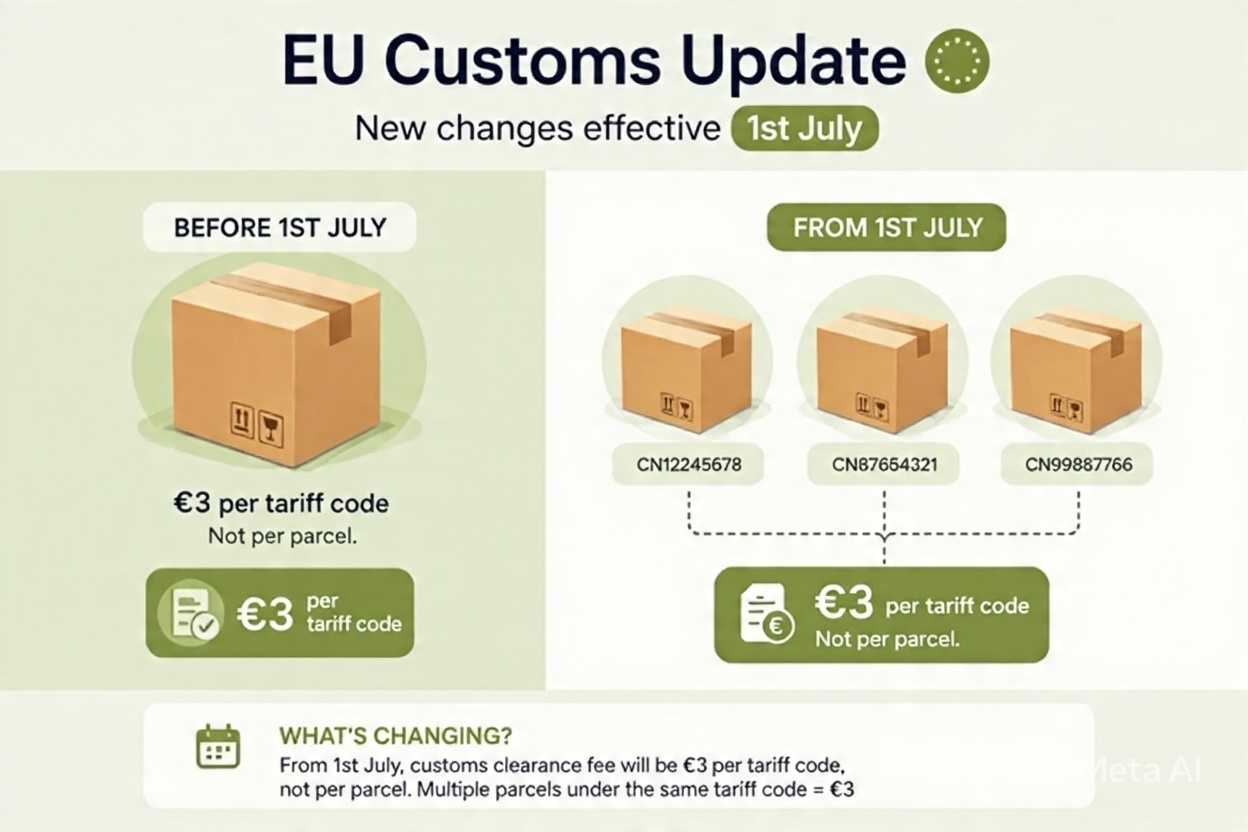
From 1st July 2026, that exemption is permanently gone, and instead all parcels under €150 will carry a flat customs duty of €3 per customs item.
The €3 flat rate is a transitional measure. It runs from 1st July 2026 until 1st July 2028. After that, the EU plans to move to a more detailed system with five tariff brackets (0%, 5%, 8%, 12%, or 17%) based on what the product actually is and where it was made.
WHY IS THE EU DOING THIS?
Cross-border e-commerce has grown massively over the past decade, especially low-value shipments from outside the EU. EU customs authorities estimate they now handle billions of small parcels each year. Processing all of them under the previous system, with no per-parcel revenue, became unsustainable.
EU-based retailers complained that overseas sellers had a structural pricing advantage. A small business in the Netherlands selling locally has to charge VAT and could not avoid duties on imported goods. An overseas seller could ship directly to Dutch consumers and skip the duty entirely, as long as the parcel was under €150.
HOW IS THE CHARGE CALCULATED?
This is the part most people get wrong, so it is worth slowing down on.The €3 fee is not charged per product. It is not even charged per parcel. It is charged per 'customs item'.
A customs item is defined by three things in combination: the 6-digit HS tariff code (which describes what the product is), the customs description (the written description of the product), and the country of origin (where the product was actually manufactured).
Multiple products that share all three of these things count as one customs item. That means several identical products in the same order attract one €3 charge, not several. But the moment any of the three factors change between two products in the same order, they become separate customs items, and each attracts its own €3 charge.
HOW DOES THIS AFFECT YOUR TOP FABRIC ORDER?
Fabrics, trims and buttons will have different HS (customs) Codes. This is what affects the charge:
One customs item: €3 in duty.
A quantity of one fabric. One product, one HS code, one description, one origin. One charge.
Two customs items: €3 in duty.
A quantity of two of the same or similar fabric. Same product, different finish but same HS Code means only one charge.
Five customs items: €15 in duty.
A quantity of a linen fabric, a cotton fabric, a silk fabric, a set of buttons and a metre of trim. Five different product categories, each with its own HS code. Five separate charges.
Two customs items: €6 in duty.
A quantity of silk dupion and a quantity of silk satin. Similar materials and composition, different HS Codes, two charges. Or, a set of metal buttons and a set of plastic buttons. Similar products, different materials and composition, different HS Codes, two charges.